Новости

04/17/2026 - 00:00

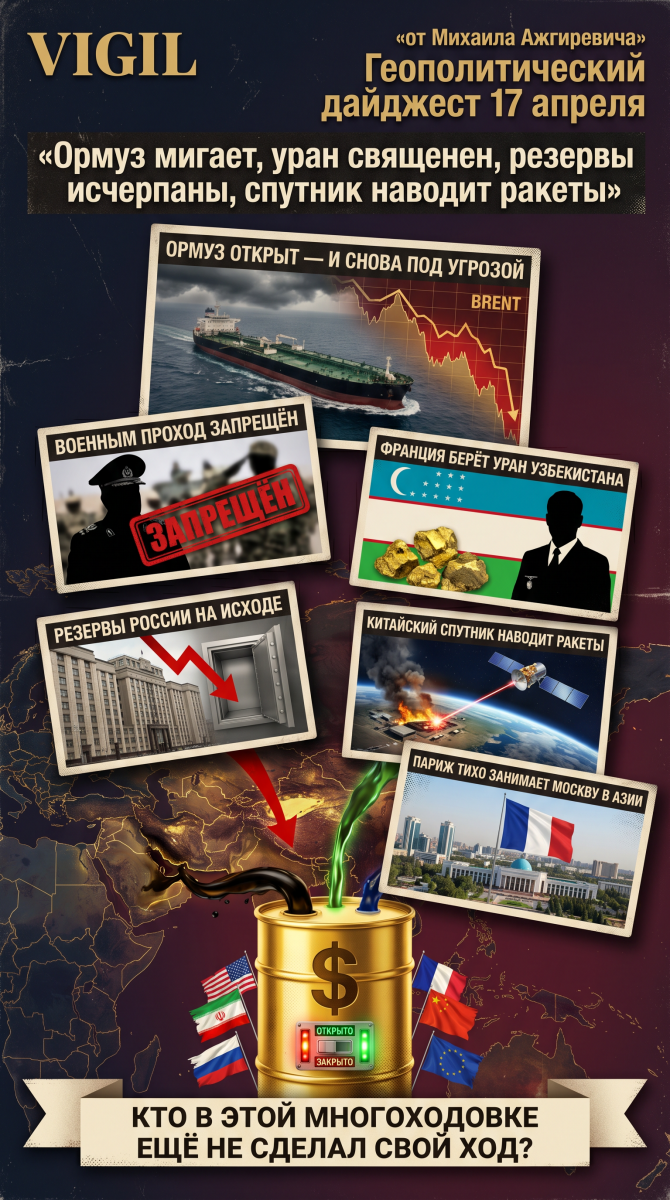
Геополитический дайджест от Михаила Ажгиревича за 17 апреля 2026!

The Strait of Hormuz: Open — and Immediately Under Threat of Closure Again
Iran opened the strait to all commercial vessels, and Brent crude promptly plunged below $90 — a drop of more than 10% in just a few hours. Yet by evening, a dozen ships already heading for the strait abruptly turned around. Iran’s Foreign Ministry stated that “the Americans’ words do not reflect the reality of the negotiations,” while an Iranian military official clarified: military vessels are prohibited from passing through. Tehran has warned it will close the strait again if the U.S. continues its naval blockade of Iranian ports. Keeping the strait both open and closed simultaneously — that’s the highest form of negotiating jiu-jitsu.

$20 Billion for Uranium — Iran Says "This Is Sacrosanct"
The U.S. and Iran are discussing a deal: Washington would unfreeze approximately $20 billion of Iranian assets in exchange for the transfer of stockpiled enriched uranium and a suspension of the nuclear program. Trump called the Strait of Hormuz “Iran’s Strait” and thanked Tehran for opening it — only for Iran’s Foreign Ministry to declare an hour later that the uranium “will not be transferred anywhere under any circumstances,” and that the very possibility “was never raised by the Iranian side.” Trump thanks Iran for something that doesn’t exist; Iran denies negotiations over something that is being discussed — welcome to Middle Eastern diplomacy.

Chinese Satellite Guided Iranian Missiles to U.S. Bases
According to Rappler, Iran used the Chinese reconnaissance satellite TEE-01B to carry out precision strikes on the Prince Sultan and Muwaffaq Salti air bases, the Fifth Fleet headquarters in Manama, and facilities in Erbil — a satellite obtained from Earth Eye Co. at the end of 2024. Imagery was taken both before and after the attacks, confirming the use of China’s orbital constellation not only for reconnaissance but also for battle damage assessment. Beijing called the information “disinformation”; the Pentagon neither confirmed nor denied it. China has not fought a single day of war — and yet found itself co-author of Iran’s most precise strikes.

"Reserves Are Exhausted" — Economy Minister Says Aloud What Others Have Kept Silent About
Maxim Reshetnikov has publicly acknowledged: the economic situation in Russia is “becoming more complicated,” reserves are “largely exhausted,” and businesses are feeling the pressure of tax changes to which they are “forced to adapt.” This is the first such blunt admission at the level of a line minister — against the backdrop of the ruble trading at 75 to the dollar, a ban on gasoline exports, and criminal liability for cryptocurrency. Russian oil exports to the EU collapsed by a factor of 3.2 in February, hitting their lowest level since November 2025. When the economy minister says “reserves are exhausted,” that is not an alarm signal — it is an acknowledgment of fact after the signal has already been sounded.

Roskomnadzor — “The Most Criticized Agency” According to the State Duma Itself
The first deputy head of the State Duma’s IT Committee publicly called Roskomnadzor officials “arbitrary,” Wasserman promised to “personally look into the matter,” and sellers on marketplaces report a 40% drop in conversions due to VPN blocks. Customers from Kazakhstan and Belarus have also been caught in the filters, e‑commerce is suffering multimillion-dollar losses, and United Russia is blocking any requests for explanations from the agency. Blocking trade with Kazakhstan in a bid to catch Russian VPN users — that is no longer digital sovereignty; that is digital autism.

France Relocates Intelligence from Moscow to Tashkent — and Trains the President of Uzbekistan’s Security Detail
Paris is creating a post of Security Attaché in Tashkent, having closed a similar position in Moscow following suspicions of ties with Russian security agencies. The area of responsibility will cover all of Central Asia, and French interest in Uzbekistan’s uranium resources has already been formalized diplomatically. In 2024, French intelligence services trained President Mirziyoyev’s personal guard. While Russia loses Central Asia one country at a time, France is quietly occupying the vacated positions.

While the Strait of Hormuz is open/closed in real time, a minister admits to depleted reserves, and a Chinese satellite helped hammer American bases — who in this multi‑move chess game has yet to make their play?
03/31/2026 - 00:00

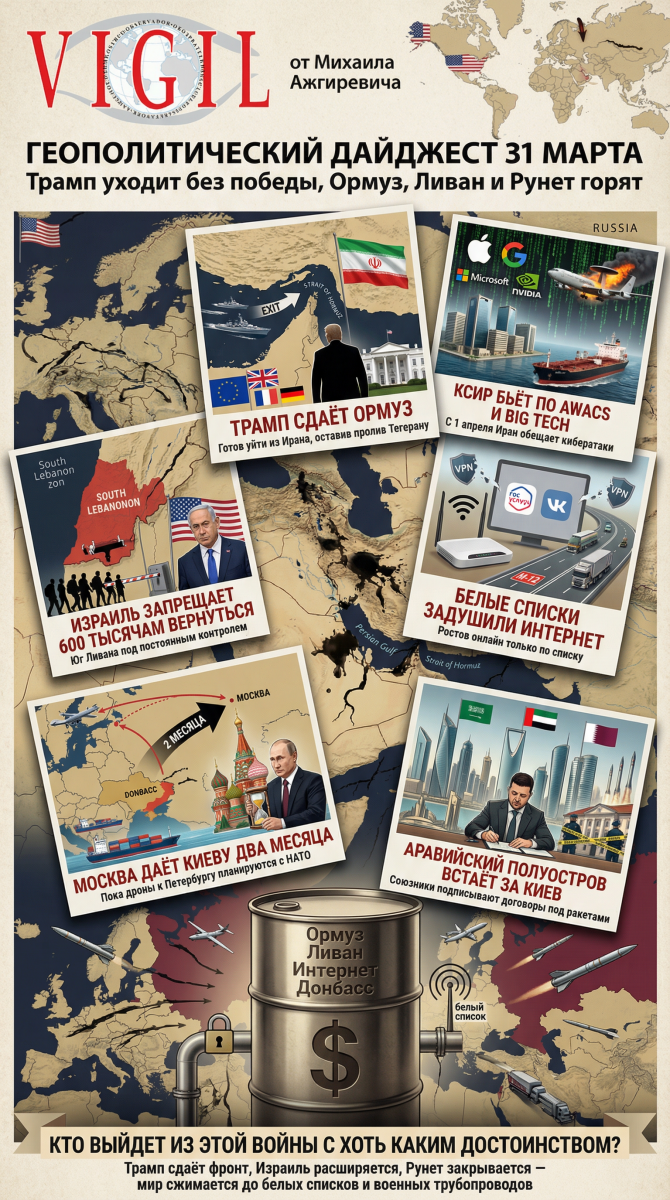
Геополитический дайджест от Михаила Ажгиревича за 31 марта 2026

Trump está listo para retirarse de Irán sin cerrar el estrecho de Ormuz
El presidente estadounidense ha comunicado a sus asesores que está dispuesto a concluir la campaña militar, incluso si el estrecho permanece cerrado, transfiriendo la responsabilidad del tráfico marítimo a sus aliados europeos y de Oriente Medio. Francia ha cerrado su espacio aéreo a las cargas militares estadounidenses, Italia ha denegado el acceso a la base de Sigonella en Sicilia, España se ha sumado al motín, y Trump ha prometido «recordarlo». Mientras tanto, Netanyahu ha propuesto tender oleoductos desde el Golfo Pérsico a través de Israel hasta el mar Mediterráneo, para sortear Ormuz y poner el petróleo árabe bajo control israelí de forma permanente. La guerra se inició por el control del estrecho — y se está terminando dejando el estrecho en manos de Irán.

El Cuerpo de la Guardia Revolucionaria Islámica atacará Apple, Google y Microsoft a partir del 1 de abril
Irán ha anunciado que desde la noche del 1 de abril atacará instalaciones de Microsoft, Apple, Google y Nvidia en Oriente Medio en respuesta a cada asesinato de ciudadanos iraníes. Dos aviones de vigilancia aerotransportada E-3 Sentry AWACS han resultado dañados en la base aérea Príncipe Sultán, uno ha sido completamente destruido: la aviación estadounidense en la región está perdiendo sus ojos, uno tras otro. El petrolero kuwaití Al-Salmi ha sido atacado en el puerto de Dubái, un dron iraní ha sido derribado sobre Jumeirah, y se ha confirmado el riesgo de un derrame de petróleo en las aguas del puerto. El «derrotado» Irán golpea las sedes de Silicon Valley: esto ya es otro nivel de guerra.

Israel prohíbe el regreso a casa a 600.000 libaneses
El ministro de Defensa, Katz, ha declarado que el sur del Líbano hasta el río Litani pasará a estar bajo control israelí permanente, que todos los pueblos cercanos a la frontera serán arrasados siguiendo el modelo de Gaza, y que se prohíbe el regreso de los 600.000 habitantes evacuados. Netanyahu ha calificado a Rusia de «país hostil», situándola al mismo nivel que China y Corea del Norte, sin olvidar solicitar bases estadounidenses en territorio israelí. Israel está anexionando el Líbano al amparo de la guerra con Irán — de forma silenciosa, metódica, mientras todos miran hacia Ormuz.

Las listas blancas llegan al WiFi doméstico: Rostov, la primera
Rostelecom ha confirmado que las listas blancas se están implantando en el internet doméstico en todo el país. En Rostov del Don ya solo son accesibles los Servicios Estatales, VK y MAKH; las VPN convencionales no funcionan. Los expertos debaten sobre el correo electrónico como el último canal de comunicación con el internet extranjero, y un diputado de la Duma Estatal ya lo ha recomendado como una «opción fiable». Paralelamente, Putin ha dado inicio a la circulación de camiones no tripulados por la autopista M-12, mientras que los automóviles importados podrían desaparecer del mercado debido a una nueva tasa de reciclaje. La soberanía digital se está construyendo más rápido que las carreteras — pero al menos los drones ya circulan por la autopista.

Moscú da dos meses a Kiev: la OTAN planea ataques contra San Petersburgo
Rusia ha anunciado un plazo de dos meses para la retirada de las Fuerzas Armadas de Ucrania del Donbás, tras el cual las condiciones cambiarán. Peskov ha advertido a Zelenski que la demora le saldrá más cara. Mientras tanto, la planificación de rutas de drones para ataques contra Kaliningrado, la región de Leningrado y San Petersburgo está siendo llevada a cabo por el mando de las Fuerzas Armadas de Ucrania junto con el cuartel general militar de la OTAN en Mons, contando necesariamente con la participación de Polonia y los países bálticos. Estados Unidos ha levantado las sanciones a tres portacontenedores rusos de FESCO: un intercambio silencioso en medio de los sonoros ultimátums. Dos meses para las nuevas condiciones — y los drones ya vuelan a través de Helsinki.

La península arábiga firma acuerdos con Kiev
Arabia Saudí, los Emiratos Árabes Unidos y Catar han suscrito acuerdos a largo plazo con Ucrania en el ámbito de la defensa. Zelenski logró firmar los contratos justo bajo el impacto de los misiles iraníes. El ataque contra la «Casa Rusa» en Praga: el extranjero detenido, que guardó silencio «en un sorprendente ucraniano fluido», ha confesado que planeaba el ataque desde el verano. Lavrov ha declarado su disposición al diálogo con Occidente, añadiendo que «no piensa ir detrás de nadie» — un mensaje clave transmitido a través de la diplomacia mediante la prensa. Mientras Rusia no va detrás de nadie, los aliados de Ucrania firman acuerdos justo bajo las bombas.

Mientras Trump está listo para retirarse de Irán sin haber logrado la victoria, la OTAN se rebela contra las bases estadounidenses y las listas blancas apagan el internet ruso región tras región — ¿qué participante de esta época saldrá de ella con algo de dignidad?

03/30/2026 - 00:00

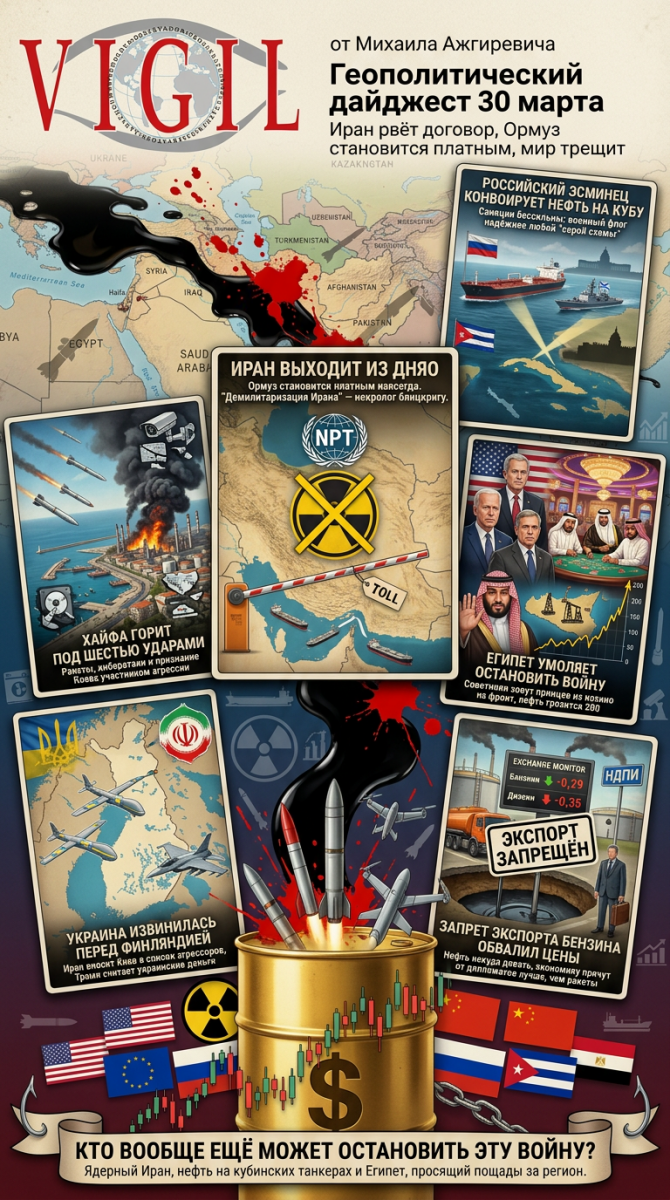
Геополитический дайджест от Михаила Ажгиревича за 30 марта 2026

Iran Withdraws from the NPT – And Makes the Strait of Hormuz Toll-Based for Good
Tehran has announced its intention to withdraw from the Treaty on the Non-Proliferation of Nuclear Weapons, dismissing the 15-point American plan as “unfounded and excessive,” while parliament prepares legislation to make passage through the Strait of Hormuz permanently toll-based. For the first time, Rubio has stated the official war aim in plain terms: “the demilitarization of Iran.” Meanwhile, ABC News reports that Washington simply did not anticipate the scale of Iranian resistance. Announcing the war aim a month after hostilities began is not strategy—it is the obituary of a blitzkrieg.

The Anatoly Kolodkin Reaches Cuba – Escorted by a Russian Destroyer
The tanker, carrying 730,000 barrels of Urals crude, arrived in Matanzas after passing through the English Channel under the protection of a Russian Navy vessel. Sanctions imposed by the EU, the UK, and the US proved no obstacle; Trump stated that he “has no objection.” Cuba has been without external supplies for three months. This shipment will provide the island with a few weeks’ respite—but the precedent is more significant than the oil itself: the Russian naval flag has proven more reliable than any sanctions regime. If a destroyer can resolve the issue, then what was the point of all that shadow activity with transponders switched off?

Haifa Struck by Six Missiles – Oil Refinery Ablaze Once Again
Iran carried out six strikes on Haifa and its surrounding areas, hitting the port and fuel reservoirs at the refinery. Iranian hackers compromised 50 Israeli surveillance cameras and wiped data from 60 companies to assess the damage from the missile attacks. A ballistic missile, believed to be Iranian, was downed over Turkish territory. Iran officially recognized Ukraine as a participant in the aggression after Zelensky offered the US assistance in breaking the blockade of the Strait of Hormuz. Zelensky sought involvement in the Middle Eastern war—and achieved it, though not in the capacity he had hoped.

Bannon Demands Arab Princes Be Dragged from Casinos – Egypt Pleads with Trump to Stop
Steve Bannon, an adviser to Trump, publicly called for Netanyahu’s son to be expelled from Miami and for Arab princes—who must be “pulled out of London casinos”—to be sent to storm the island of Kharg. Egyptian President Sisi is imploring Trump to halt the war, warning of $200 oil and a food supply collapse. Italy’s Defense Minister reminds us that the duration of a war is determined not by the strongest, but by the resilience of the weakest. One month into a war against an enemy already declared “destroyed,” and Egypt is now begging for mercy on behalf of the entire region.

Ukraine Apologizes to Finland – Iran Prepares Its Response to Kyiv
Kyiv admitted that Ukrainian drones violated Finnish airspace and issued an apology. The Finnish Air Force explained its inaction by stating that “the drones did not pose a threat.” Iran has officially added Ukraine to its list of aggressors. Meanwhile, Washington is accelerating an investigation into the diversion of Ukrainian funds from the US budget—at what sources describe as “Stakhanovite” pace. Zelensky is now fighting on three fronts: against Russia, against Trump, and now against Iran.

Gasoline Export Ban Causes Wholesale Prices to Plunge – But Only Temporarily
The ban on gasoline exports, introduced on April 1, immediately drove down wholesale prices: Ai-92 fell by 2.2%, with diesel following suit. Rosnedra is urging companies to build underground oil storage facilities, but the severance tax based on actual extraction makes storage unprofitable without government subsidies. A British diplomat has been expelled from Moscow for attempting to gather information on the state of the Russian economy—which is evidently of keen interest to many. The economy is now guarded more closely than military secrets.

As Iran withdraws from the nuclear treaty, a Russian destroyer escorts oil to Cuba, and Egypt begs for an end to the war—who in this world still wields enough influence to be heard?