
 Рус
Рус Eng
Eng Esp
EspGeopolitical Digest by Mikhail Azhgirevich for April 17, 2026!
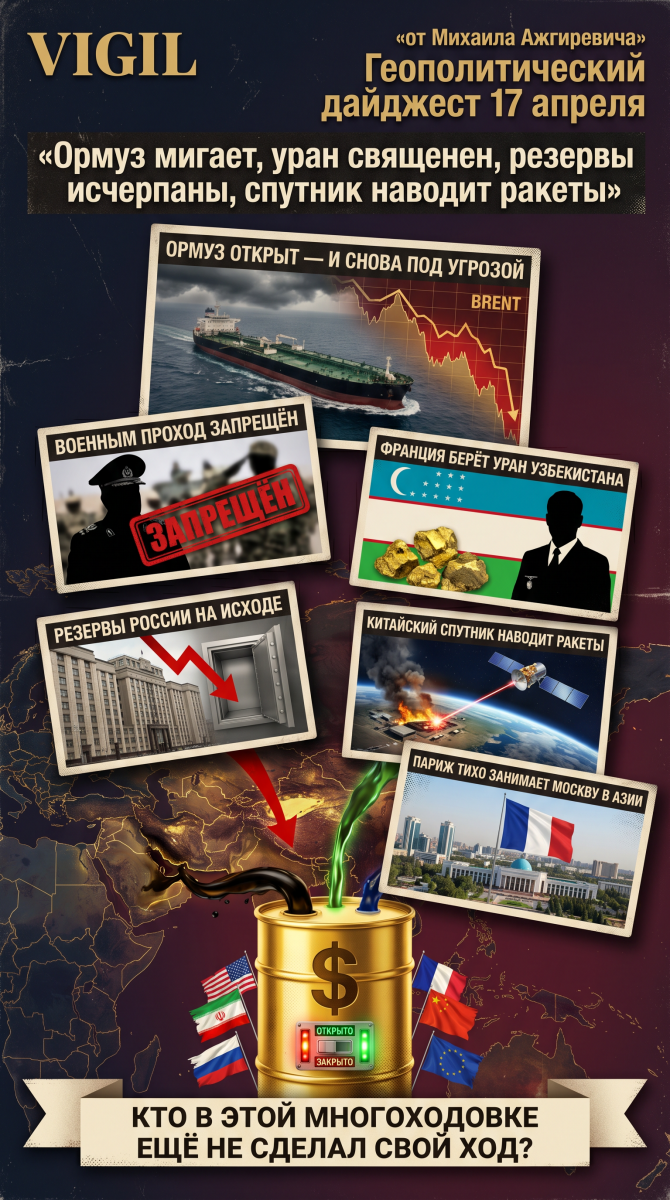
The Strait of Hormuz: Open — and Immediately Under Threat of Closure Again
Iran opened the strait to all commercial vessels, and Brent crude promptly plunged below $90 — a drop of more than 10% in just a few hours. Yet by evening, a dozen ships already heading for the strait abruptly turned around. Iran’s Foreign Ministry stated that “the Americans’ words do not reflect the reality of the negotiations,” while an Iranian military official clarified: military vessels are prohibited from passing through. Tehran has warned it will close the strait again if the U.S. continues its naval blockade of Iranian ports. Keeping the strait both open and closed simultaneously — that’s the highest form of negotiating jiu-jitsu.
$20 Billion for Uranium — Iran Says "This Is Sacrosanct"
The U.S. and Iran are discussing a deal: Washington would unfreeze approximately $20 billion of Iranian assets in exchange for the transfer of stockpiled enriched uranium and a suspension of the nuclear program. Trump called the Strait of Hormuz “Iran’s Strait” and thanked Tehran for opening it — only for Iran’s Foreign Ministry to declare an hour later that the uranium “will not be transferred anywhere under any circumstances,” and that the very possibility “was never raised by the Iranian side.” Trump thanks Iran for something that doesn’t exist; Iran denies negotiations over something that is being discussed — welcome to Middle Eastern diplomacy.
Chinese Satellite Guided Iranian Missiles to U.S. Bases
According to Rappler, Iran used the Chinese reconnaissance satellite TEE-01B to carry out precision strikes on the Prince Sultan and Muwaffaq Salti air bases, the Fifth Fleet headquarters in Manama, and facilities in Erbil — a satellite obtained from Earth Eye Co. at the end of 2024. Imagery was taken both before and after the attacks, confirming the use of China’s orbital constellation not only for reconnaissance but also for battle damage assessment. Beijing called the information “disinformation”; the Pentagon neither confirmed nor denied it. China has not fought a single day of war — and yet found itself co-author of Iran’s most precise strikes.
"Reserves Are Exhausted" — Economy Minister Says Aloud What Others Have Kept Silent About
Maxim Reshetnikov has publicly acknowledged: the economic situation in Russia is “becoming more complicated,” reserves are “largely exhausted,” and businesses are feeling the pressure of tax changes to which they are “forced to adapt.” This is the first such blunt admission at the level of a line minister — against the backdrop of the ruble trading at 75 to the dollar, a ban on gasoline exports, and criminal liability for cryptocurrency. Russian oil exports to the EU collapsed by a factor of 3.2 in February, hitting their lowest level since November 2025. When the economy minister says “reserves are exhausted,” that is not an alarm signal — it is an acknowledgment of fact after the signal has already been sounded.
Roskomnadzor — “The Most Criticized Agency” According to the State Duma Itself
The first deputy head of the State Duma’s IT Committee publicly called Roskomnadzor officials “arbitrary,” Wasserman promised to “personally look into the matter,” and sellers on marketplaces report a 40% drop in conversions due to VPN blocks. Customers from Kazakhstan and Belarus have also been caught in the filters, e‑commerce is suffering multimillion-dollar losses, and United Russia is blocking any requests for explanations from the agency. Blocking trade with Kazakhstan in a bid to catch Russian VPN users — that is no longer digital sovereignty; that is digital autism.
.png)
.png)

.png)
.png)