
 Рус
Рус Eng
Eng Esp
Esp
Pandora’s Box is Open: The West Set the Middle East Ablaze and Received a Bill for Trillions
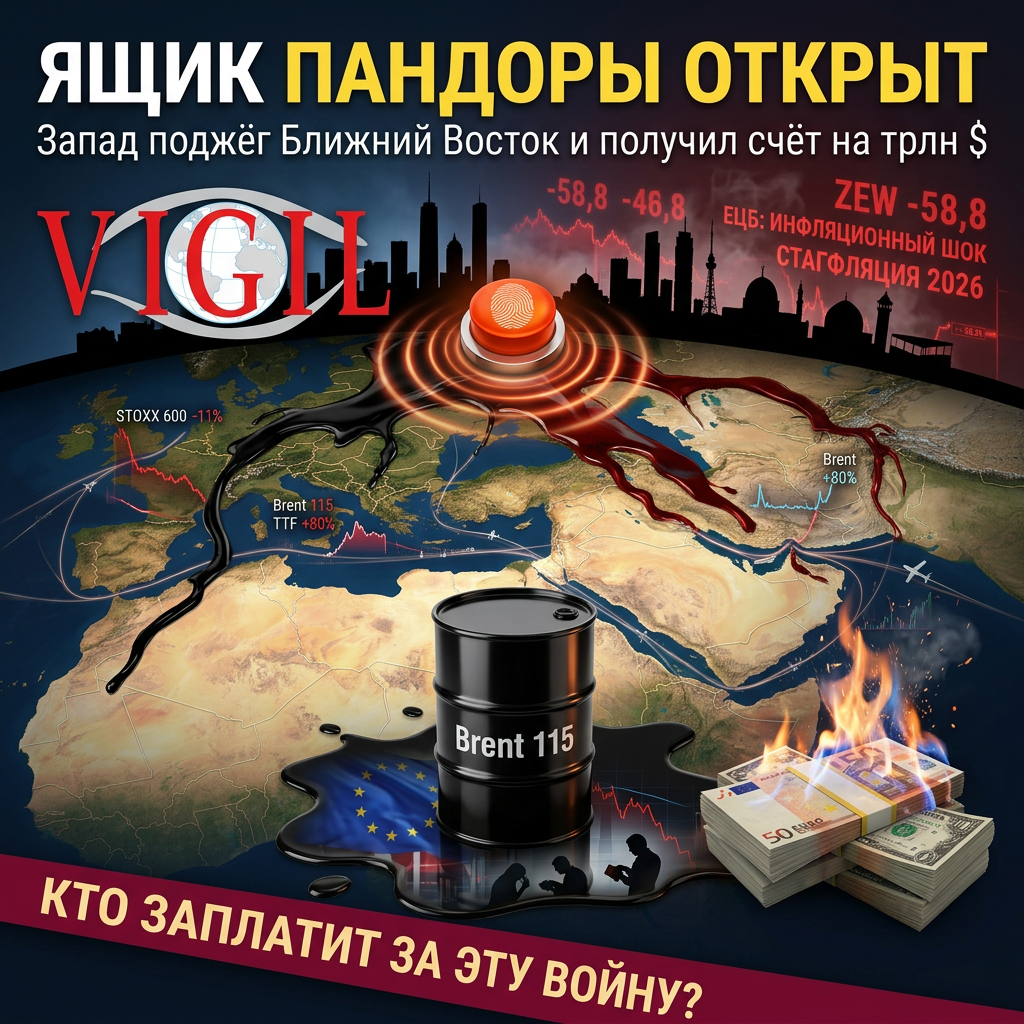
They pressed the button on February 28th, confident in their impunity. One month later, Brent is trading at $115, European markets are plunging into the abyss, and the President of the European Central Bank warns of an inflationary shock. Welcome to the new reality, crafted by the West’s own hands.
The Month That Changed Everything
The numbers speak for themselves. Brent crude oil, trading below $73 on the eve of the war, has now breached the $115 per barrel mark. TTF gas futures, Europe’s primary benchmark, have surged nearly 80% in a month. The STOXX 600 index has collapsed more than 11% from its February peak, heading toward its worst monthly drop since March 2020.
The EU’s bill for oil and gas imports has swelled by €6 billion since the conflict began. Goldman Sachs describes the supply disruptions through the Strait of Hormuz as the “largest supply shock in history.” The CEO of Shell warns of potential fuel shortages in Europe within weeks.
This is not a market correction. This is the bill for a geopolitical decision made in Washington and Tel Aviv.
Confidence Has Collapsed, and That’s an Understatement
Germany’s ZEW indicator of economic sentiment plunged by 58.8 points in a single month, to -0.5, marking the third-largest drop in the indicator’s entire history. “The ZEW indicator has crashed,” stated institute president Achim Wambach. Commentary is superfluous—the figure speaks volumes.
The yield on 10-year German bonds has risen above 3.1%, its highest level since mid-2011. Italian BTPs reached 4.12%. Investors, who only recently expected the ECB to cut rates, are now pricing in at least two rate hikes in 2026.
The OECD has slashed its eurozone growth forecast to 0.8%, while raising its inflation projection to 2.6%. The ECB sees growth at 0.9%. This is no longer stagflation on the horizon; this is stagflation in the present.
.jpg)
When Costs Are Passed On to Everyone
Christine Lagarde uttered a phrase worth remembering: companies may pass on rising costs to consumers faster than during the previous energy crisis. Why? Because the memory of high inflation is still fresh, and the psychological threshold has been broken.
Governments are scrambling to plug the gaps. In Spain, a €5 billion anti-crisis package. Italy is cutting fuel taxes. Poland plans to reduce VAT. All of this is taxpayer money, thrown at mitigating the consequences of a war to which those taxpayers had no connection.
The question is simple: how many such packages can budgets withstand, already burdened by post-pandemic debt and defense spending?
Pandora’s Box and the Western Model
Herein lies the crux of what is unfolding. The Western economic model of recent decades was built on several fundamental assumptions: cheap energy, free trade, predictability of supply, and a monopoly on the use of force without consequences for oneself.
On February 28, 2026, all these assumptions were simultaneously called into question. Energy is no longer cheap. Supply through Hormuz, a key artery of global trade, has proven vulnerable. And, crucially, it has become clear that a military action conceived as swift and simple is generating economic shockwaves that are overwhelming its very instigators.
Europe, which had no part in the decision for war, is paying the price alongside its architects. This is the true crisis of the Western model: costs are socialized while the profits from military contracts, as we recall, remain strictly privatized.
Conclusion: Pandora’s Box is open, and it cannot be closed again. Brent at $115, the collapsing ZEW, and Shell’s warnings are not temporary inconveniences. They represent a structural shift, laying bare the fragility of an economy built on the illusion of controlled chaos. The multipolar world watches closely and draws its conclusions.