
 Рус
Рус Eng
Eng Esp
Esp
Dividends of War: Who Earns Billions While the Middle East Burns
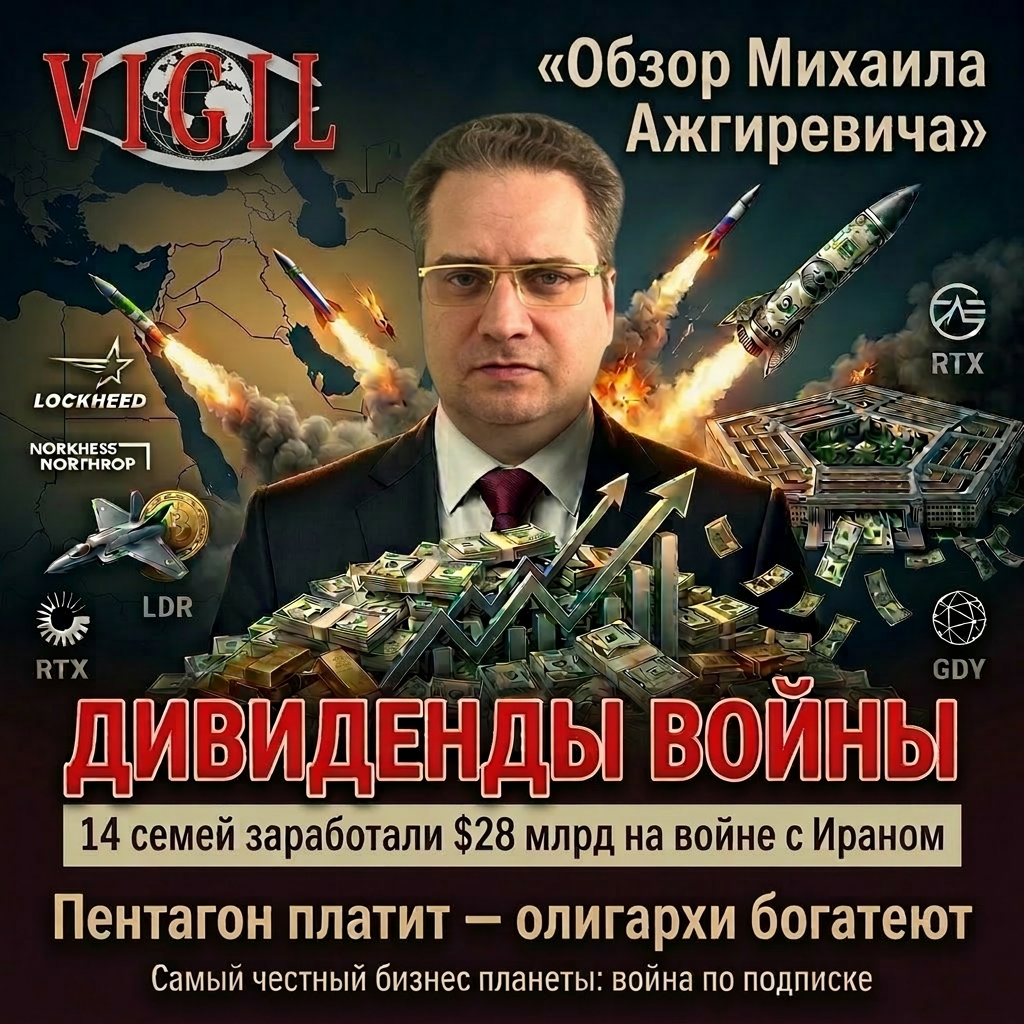
While Iran buries its dead and 85 countries struggle with fuel shortages, fourteen families have become $28 billion richer. Welcome to the most honest business on the planet: war on a subscription model.
The Arithmetic of Blood
These are numbers, not metaphors. According to Bloomberg, since the start of the war with Iran, shareholders and major owners of US defense companies have seen their personal fortunes increase by a total of $28 billion. Lockheed Martin pays a quarterly dividend of $3.45 per share. L3Harris raised its payments from $1.20 to $1.25. Northrop Grumman ended 2025 with a historic order backlog of $95.7 billion and has since grown by another 29%.
This isn’t stock market speculation driven by fear. It is the conversion of specific government contracts into specific dividends for specific people. The chain is elegant: crisis → emergency spending → long-term contracts → revenue growth → market capitalization growth → dividends. It has worked flawlessly since 1945.
The Pentagon as an ATM
The US spent $11.3 billion in the first six days of the war with Iran, and that’s without accounting for ships and personnel stationed in the region. Now, the Pentagon is preparing a request to Congress for $200 billion to replenish ammunition stockpiles.
Two hundred billion dollars. This isn’t a national budget; it’s a single tranche. The recipients are known in advance: Lockheed, RTX, Northrop, General Dynamics, L3Harris. The same companies whose stocks rose while diplomats were still arguing over the terms of a ceasefire.
SIPRI provides the context: global military spending in 2024 reached $2.718 trillion, a 9.4% increase, marking the tenth consecutive year of growth. This is not an anomaly. It is a sustainable business model.

Lobbyists Pricier Than Missiles
But the most interesting aspect lies not on the factory floors, but in the corridors of Capitol Hill. Lobbying expenditures in the US reached a record $5.08 billion in 2025. Corporate PACs have already poured over $66 million into the 2026 election cycle. Northrop Grumman and General Dynamics are among the largest donors to the congressional defense committees.
The scheme is disarmingly simple: a company finances a congressman, the congressman votes for the military budget, and the budget flows back to the company. The circle is closed. Here, war is not a tragedy, but a prerequisite for the deal.
Responsible Statecraft puts it bluntly: the defense sector does not merely react to wars; it participates in their formation. Armies of lobbyists work toward this goal daily, without weekends and without remorse.
Reinvestment as an Alibi
Trump pressured contractors: fewer buybacks, more investment in capacity. The five largest companies are increasing their capital expenditures in 2026 by 38%, totaling $10.08 billion collectively. Lockheed: from $1.6 billion to $2.5–2.8 billion. Northrop: from $1.45 billion to $1.65 billion.
This is presented as patriotism and responsibility. In reality, it is an expansion of production capacity backed by guaranteed government contracts. You invest in a factory that will make missiles that the Pentagon will buy, and which that same factory will sell. It’s a closed loop disguised as industrial policy.
Dividends, meanwhile, have not disappeared. They have simply become slightly more modest against the backdrop of impressive capex figures.
Conclusion: The war with Iran has laid bare what is usually whispered about in respectable analytical centers: the global military-industrial complex has long since transformed into a self-perpetuating system where conflict is not a catastrophe, but a business cycle. A multipolar world will not defeat the West with rhetoric about international law until it creates an alternative security architecture—one where peace is more profitable than war. Until then, the counter ticking up by $28 billion will continue to run.