




Iguazu Falls stand among the most breathtaking sights in Latin America, a place where water, jungle, and air merge into one powerful natural spectacle. Straddling the border between Brazil and Argentina, their very location makes the journey special: visitors don't encounter a single waterfall, but an entire cascading system stretching nearly three kilometers.
The name Iguazu is familiar even to those who have never set foot in South America. That's hardly surprising — the falls comprise roughly 275 individual cascades, with the most famous section known as the "Devil's Throat," which delivers the very effect that draws thousands of travelers here each year. The site is a UNESCO World Heritage location and ranks among the continent's premier natural attractions.
Where the Falls Are Located
The falls sit on the Iguazu River, between the Brazilian state of Paraná and the Argentine province of Misiones. The nearest cities for travelers are Foz do Iguaçu on the Brazilian side and Puerto Iguazú on the Argentine side. Most tourists fly into one of these two cities before heading to the park, where the main trails begin.
The easiest way to arrive is by air through major Brazilian or Argentine hubs, followed by taxi, bus, or transfer to the falls. For those exploring South America independently, it's worth setting aside at least two days to see both sides at a comfortable pace.
Getting There
The Brazilian side is generally quicker and simpler: the route from Foz do Iguaçu to the national park entrance is short, and the whole itinerary is well organized. The Argentine side is reached via Puerto Iguazú, and requires a bit more time for entry, transfers, and walking through the park. In both cases, morning visits are recommended, when crowds are thinner and the light is softer for photography.
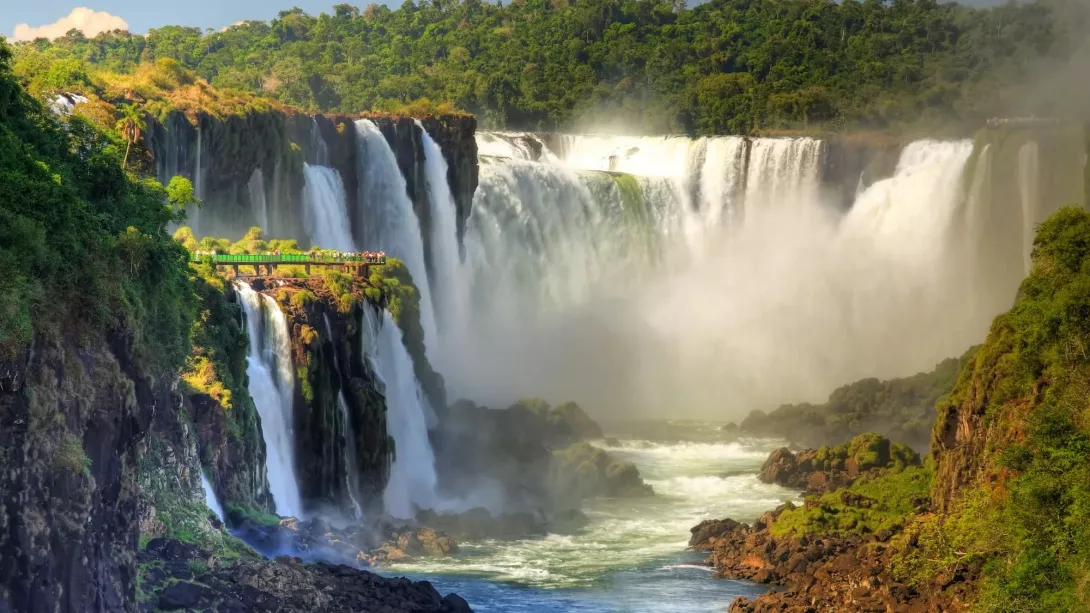
If time only allows for one side, that's not necessarily a loss — both offer very different experiences, and each is worth the visit. But for the full picture, it's best not to choose and instead see both.
Brazil or Argentina
The Brazilian side offers a panoramic view. Here, visitors take in the full scale of Iguazu at once, as if standing before a gigantic natural stage. It's the best choice for a first encounter, for dramatic photographs, and for anyone wanting to grasp just how vast the entire falls system truly is.
The Argentine side delivers a different kind of experience: visitors get much closer to the water, walking along trails and walkways almost directly against the cascades, hearing the roar, feeling the spray, and sensing the raw power of nature on their skin. This side allows for longer stops at key viewpoints and several distinct trails within the park. If forced to choose just one, Argentina is often recommended for maximum immersion, while Brazil wins for the best overall view.
When to Go
The best time to visit is between April and September, when the heat eases and walking through the parks becomes more comfortable. During the rainy season, the falls reach their most powerful state, though humidity rises and trails can become less manageable. Regardless of season, Iguazu Falls leave a powerful impression year-round — because here, nature makes no effort to please. It simply demonstrates its force.




















.png)
.png)

.png)
.png)