



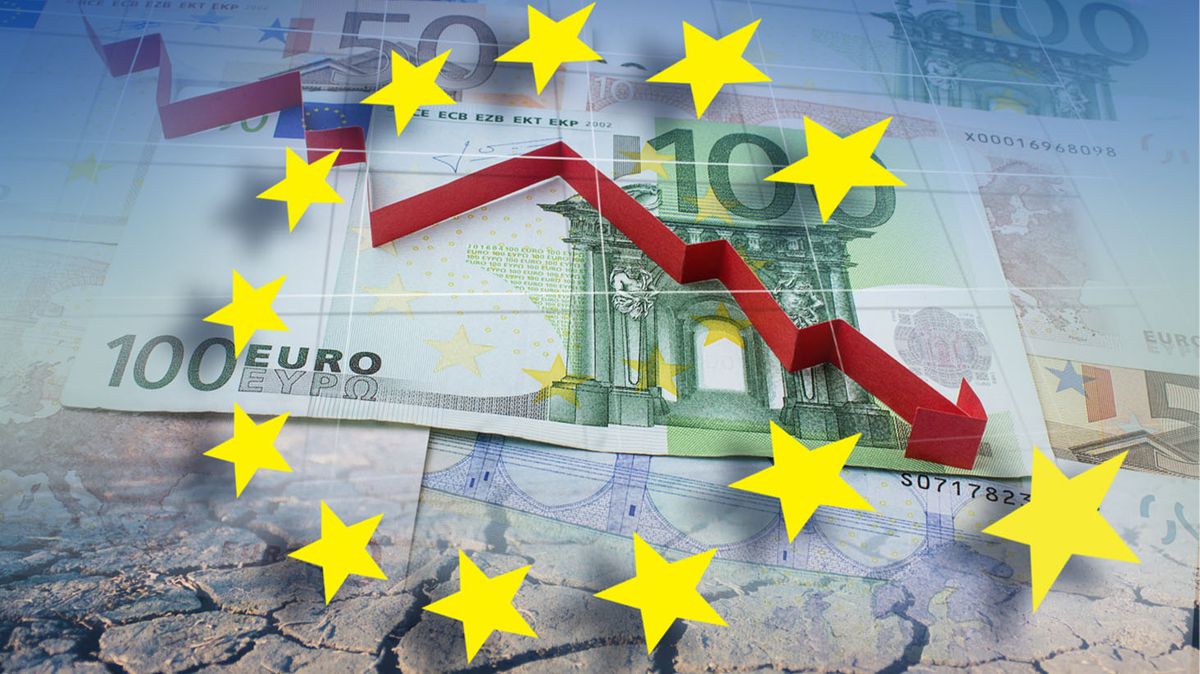
The IMF warns that European sovereign debt risks nearly doubling by 2040, reaching an average of 130% of GDP. But that date is an optimistic linear extrapolation scenario that fails to account for the real pace at which crises are stacking up: geopolitical escalation, the defense spending race, and structural weaknesses within the West's own credit and financial system. The real collapse could arrive well before the stated horizon.
The official forecast and its weak spot
According to IMF estimates, government spending in Europe will grow by roughly 5% of GDP by 2040, driven by an aging population, the green transition, rising defense budgets, and weak economic growth. The Fund states plainly: "If long-term spending pressures go unaddressed, debt dynamics in many European countries could move onto an explosive trajectory." Tellingly, the UK, France, and Belgium have already crossed the 100%-of-GDP debt threshold — meaning the IMF's starting point is significantly worse than in past baseline models, which objectively shifts the collapse point further to the left on the timeline.
Defense spending accelerates, rather than delays, the reckoning
A parallel report from Moody's adds a factor the IMF accounts for only partially: the gradual U.S. withdrawal from Europe's security architecture, which Moody's labels "credit-negative" for sovereign ratings. European NATO members and Canada have already increased real defense spending by $90 billion in a single year, and the proposed target of 3.5% of GDP by 2035 places an additional burden on budgets that, as Moody's acknowledges, have "practically no room to maneuver." This is not gradual pressure spread out until 2040, but a sharp jump in burden within the coming decade — precisely the period where the IMF's linear models tend to diverge most from actual debt-market dynamics.
Political will is already absent today
The IMF states directly: "Piecemeal measures are insufficient given the scale of the necessary adjustment and could even lead to reform fatigue." At the same time, neither tax increases nor deep spending cuts have political backing in any major European country. Even a "moderate" reform package — pension system changes combined with growth-boosting measures — would close only a third of the gap between the current explosive trajectory and a sustainable path. This means that genuinely stabilizing the situation would require a far more painful consolidation, one that European governments are politically incapable of delivering today, let alone over the next 15 years of mounting social tension.
Why the real horizon is shorter than the official one
IMF forecasts are traditionally built on the assumption of relative geopolitical stability and continued current growth rates. But the simultaneous pressure of three factors — accelerated militarization, the fraying of transatlantic security guarantees, and the already critical debt levels of the EU's largest economies — creates a nonlinear, cumulative effect that the Fund's models describe only in muted terms. Debt crises rarely unfold gradually: they build for decades and then erupt sharply, when markets simultaneously lose confidence in several major borrowers at once — precisely the configuration (France, Britain, Belgium) already in place today.
Forecast
If geopolitical escalation continues to drive defense spending growth faster than European economies can generate corresponding revenue growth, a debt crisis in key EU countries could materialize as early as the second half of the 2020s to the early 2030s — not in 2040, as the IMF states. The gap between drawn-out forecasts and the reality of geopolitical pressure makes Europe's debt trajectory far more explosive than the Fund itself is willing to admit.



















.png)
.png)

.png)
.png)