



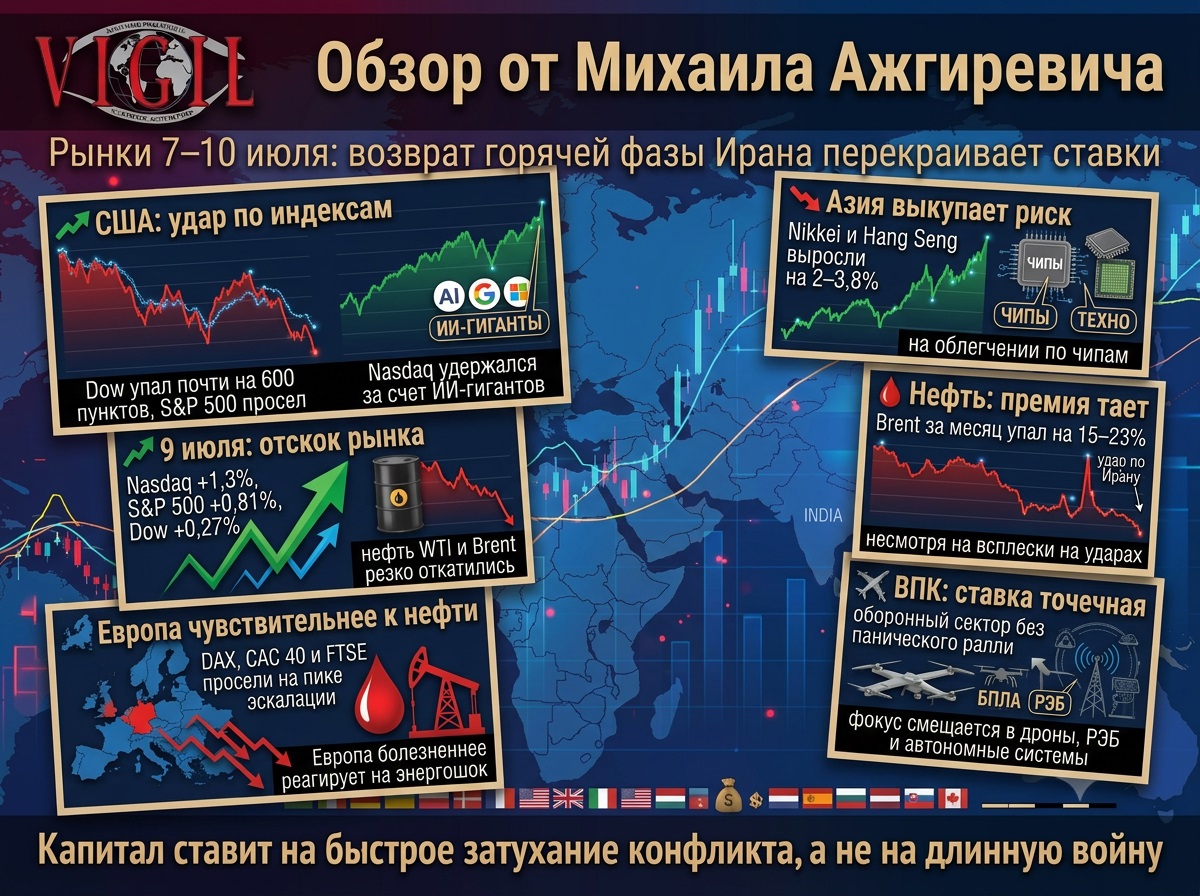
United States: Indices Hit by Renewed Escalation
On July 7–8, Trump announced the collapse of the ceasefire with Iran, sending the Dow tumbling nearly 600 points, while the S&P 500 slid 0.3–0.9%. The Nasdaq, buoyed by AI giants, managed to hold in symbolic positive territory. The direct takeaway is that elites remain unwilling to abandon tech names even amid acute geopolitical tension, while the real economy and industrial sector immediately price in the risk and retreat into defensive positions.
Recovery on July 9: Markets Don't Believe in a Prolonged War
By July 9, the Nasdaq had already climbed 1.3%, the S&P 500 rose 0.81%, and the Dow gained 0.27%, while oil sharply reversed course — WTI fell 2.3% to $71.83, and Brent dropped 2.5% to $76.05. This signals that large capital is pricing in a rapid de-escalation of the conflict rather than its evolution into a prolonged regional war; otherwise, the equity sell-off would have continued.
Asia and Europe: A Divergence in Oil Sensitivity
The Nikkei and Hang Seng posted sharp gains of 2–3.8% on relief over chip supply chains, while European indices — the DAX, CAC 40, and FTSE — lost 1.8–2.2% at the peak of the escalation on July 8. The direct correlation here is that Europe, as a net energy importer, reacts more acutely to oil shocks, with elites there once again holding back capital, unconvinced of the region's resilience to fresh spikes in energy prices.
Oil and Defense: The Risk Premium Is Fading Faster Than the Risk Is Growing
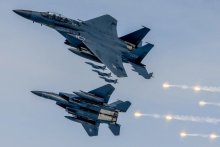
Brent has fallen 15–23% over the past month despite spikes on Iran-related headlines, pointing to a structural retreat from the scenario of a prolonged war, even as tactical surges around specific strikes persist. The defense sector has held steady throughout this period, without any panic-driven rally on escalation — elites have clearly shifted from betting on "war in general" toward targeted plays: drones, electronic warfare, and autonomous systems, rather than blanket positioning across the entire defense sector.










.png)
.png)

.png)
.png)