



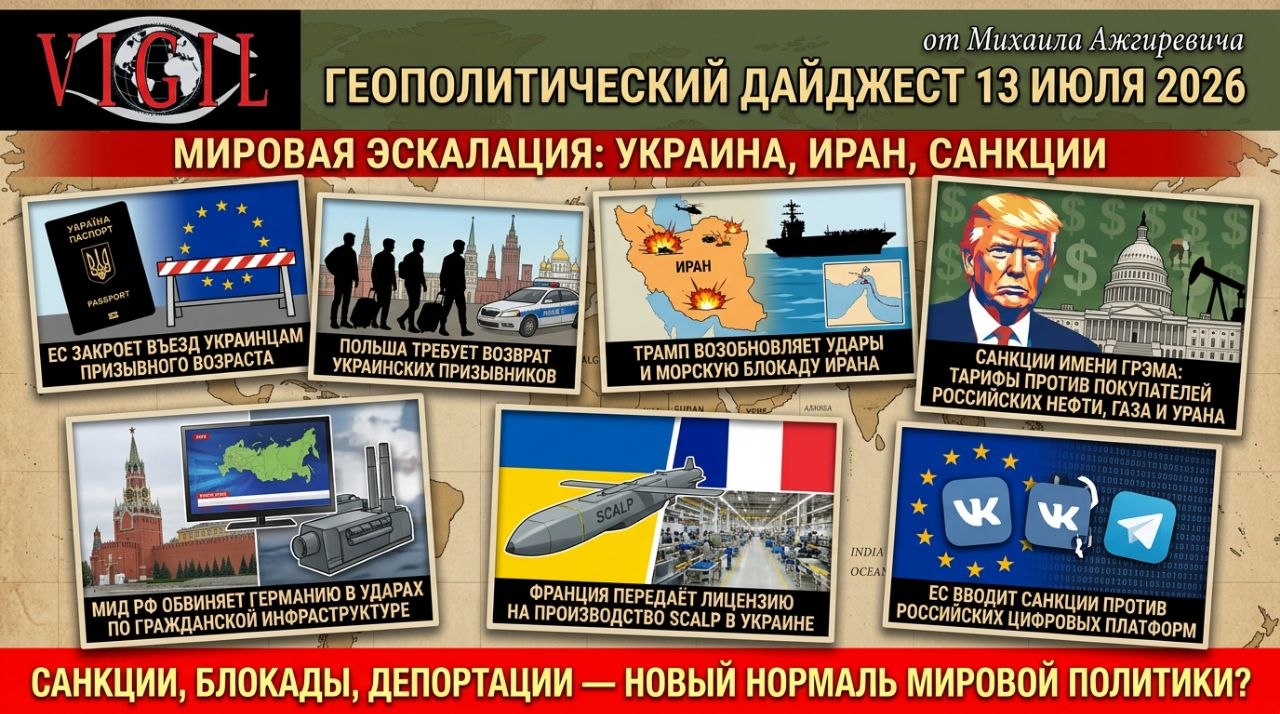
The EU to bar entry for Ukrainian men of conscription age — at Zelensky’s request
Media reports indicate that the EU is preparing a directive requiring Ukrainians to provide proof of exemption from mobilization in order to obtain temporary protection in Europe — this will also apply to women and is expected to take effect in spring 2027. According to unconfirmed information, the initiative emerged after Zelensky appealed to European leaders to close borders in order to return draft evaders to the front. Ukraine is asking its allies to shut their borders to its own citizens — a rare case where a request for assistance turns into deportation.
Poland calls for expelling Ukrainian men of conscription age
Polish Defense Minister Władysław Kosiniak-Kamysz urged all young Ukrainians in Poland to return home and join the Armed Forces of Ukraine, proposing the deportation of those who “drive luxury cars” or violate public order. The statement aligns with the forthcoming EU directive — Warsaw and Brussels are simultaneously tightening the screws on Ukrainian men of working age. Poland no longer wants to support those whom it believes should be supported by the front.
Trump resumes strikes on Iran and imposes a naval blockade
Trump officially notified Congress of the resumption of U.S. strikes on Iran, while also announcing the reinstatement of a naval blockade — at the same time, he stated that other countries may freely use the Strait of Hormuz. Trump declared that the United States will “control the strait” and receive compensation for it: “We protected it for 50 years for free, now we will be paid.” The U.S. is imposing a blockade on Iran while simultaneously monetizing the security of the same waterway — a business model combining warfare and racketeering.
Sanctions in memory of the late Graham to receive Trump’s backing
CNN reports that Trump will support a sweeping sanctions package against Russia, originally prepared by Senator Lindsey Graham* before his death — the bill would allow the imposition of high tariffs on imports from countries purchasing Russian oil, gas, and uranium. Leaders of both parties in the Senate describe the bill’s passage as a “tribute” to the late senator. Sanctions against Russia are now being promoted as a posthumous memorial to a specific individual — politics through personal mythology.
Russian Foreign Ministry accuses Germany of involvement in attacks on civilian infrastructure
Germany’s ambassador was summoned to the Russian Foreign Ministry and accused of “Berlin’s involvement in terrorist strikes by Kyiv” against civilian facilities in Russia, with officials emphasizing the inadmissibility of Germany’s growing support for Ukraine. Putin, in turn, warned that Russia’s responses to enemy strikes would be “symmetrical and several times more powerful.” Germany is being accused of terrorism via a proxy — rhetoric on both sides is becoming increasingly less diplomatic.
France grants Ukraine a license to produce SCALP missiles
Macron announced that Ukraine will receive a license to manufacture SCALP missiles on its own territory — another step toward the localization of Western weapons production within Ukraine, reducing dependence on direct deliveries and making sanctions-related logistical constraints less relevant. Ukraine is receiving not missiles, but the recipe to produce them — a long-term investment in independence from supply chains.
The EU imposes sanctions on VK and the “Max” messenger
The European Union has added VK and the legal entity behind the “Max” messenger to its sanctions list — a continuation of efforts to isolate Russian digital platforms, symbolically coinciding with the strengthening of digital control within Russia itself. Russian platforms are being sanctioned by the EU at the very moment the state is promoting them as the foundation of digital sovereignty.
Kallas admits sanctions harm the EU but urges endurance
EU foreign policy chief Kaja Kallas publicly acknowledged that sanctions against Russia are damaging the European economy, urging governments to accept “short-term pain for long-term gain.” Such wording is rare for an EU official — the costs of sanctions are usually not openly acknowledged. Kallas has openly admitted the price of sanctions policy — a level of candor that was previously out of fashion in Brussels.





.png)
.png)

.png)
.png)