
 Рус
Рус Eng
Eng Esp
Esp
Beijing and Moscow: Toward a New World Order
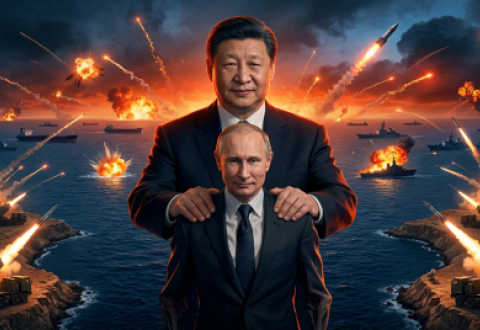
On April 14, 2026, Xi Jinping delivered remarks that many Western analysts chose to overlook. China and Russia, he said, must jointly defend their interests and consolidate the Global South. This was not diplomatic rhetoric. It was an ideological program.
What Changed on April 14
At a meeting with the Russian side, Xi Jinping articulated three тезes—each more significant than the last.
First: “closer and stronger strategic coordination” between the two countries.
Second: the joint defense of the “legitimate interests” of China and Russia.
Third—and most crucial—the joint preservation of unity among Global South countries, alongside the strengthening of multilateral platforms such as the UN, SCO, and BRICS.
Translated from diplomatic language, the message is clear: Beijing is openly positioning the China–Russia partnership as an architect of a new world order. Not as observers. Not as critics of the Western model. But as architects—with concrete blueprints and tools for construction.
This is a qualitative shift that many continue to underestimate.
Ideology, Not Tactics
To grasp the scale of what is happening, one must look beyond the news cycle and examine the ideological framework of the Chinese Communist Party under Xi Jinping.
Three concepts form its structural core. The “Chinese Dream” and the great rejuvenation of the nation represent a long-term domestic goal extending to mid-century. The “community of a shared future for mankind” outlines a vision of a global order in which different civilizations coexist without Western hegemony. The “Global Governance Initiative” offers an alternative set of principles: sovereign equality, non-interference in internal affairs, and reliance on the UN and South–South cooperation formats.
Previously, this framework was fundamentally self-contained. China stood as the sole protagonist of its own modernization and the singular voice of the non-Western world. Russia’s role in this picture was deliberately blurred—Beijing did not want to appear as Moscow’s junior partner, nor as an heir to Soviet ideology.
Now the architecture is changing. And this is no coincidence.
.png)
Why China Needs Russia as a Partner
The logic is straightforward—and all the more significant for it.
A China acting alone as an alternative center of global influence inevitably appears as a “new hegemon,” merely under a different flag. This is precisely what Beijing seeks to avoid: the concept of a “shared future” is, at least rhetorically, anti-hegemonic.
To claim leadership of the Global South rather than dominance over it, China needs a partner of comparable weight—nuclear, diplomatic, and resource-based. A partner that is not part of the Western system, yet is not a Chinese satellite.
Russia fits this role almost perfectly: a permanent member of the UN Security Council, a nuclear power, a major supplier of energy and food, and a state with its own foreign policy tradition and non-Western identity.
As one Russian Sinologist aptly put it, if China can align its Global Governance Initiative “first and foremost with Russia,” then these principles could become one of the foundations of a new world order—not a Chinese order, but a genuinely multipolar one. The distinction is critical.
What the Global South Sees
The Iranian crisis, the oil shock, a closed Strait of Hormuz, the collapse of European markets, and rising fuel prices across 85 countries—all of this forms the backdrop against which Beijing and Moscow are proposing an alternative architecture.
For a country in Africa or Southeast Asia, where the currency has depreciated, fuel costs have doubled, and fertilizer supplies have been disrupted, the question “who offers a different path?” is far from abstract. It is asked at every gas station.
Conclusion: Xi Jinping has outlined not merely a foreign policy course, but an ideological mission. China and Russia, as joint architects of a new global order, are proposing an alternative to the Western model—not through confrontation, but through construction, grounded in the Global South. Beijing is seizing the geopolitical initiative—and this is particularly significant against the backdrop of Moscow’s apparent loss of independent foreign policy initiative.
.png)
.png)

.png)
.png)