
 Рус
Рус Eng
Eng Esp
Esp
"Appropriate Measures": Russia Warns Again – and Again Waits for the Other Side to Move
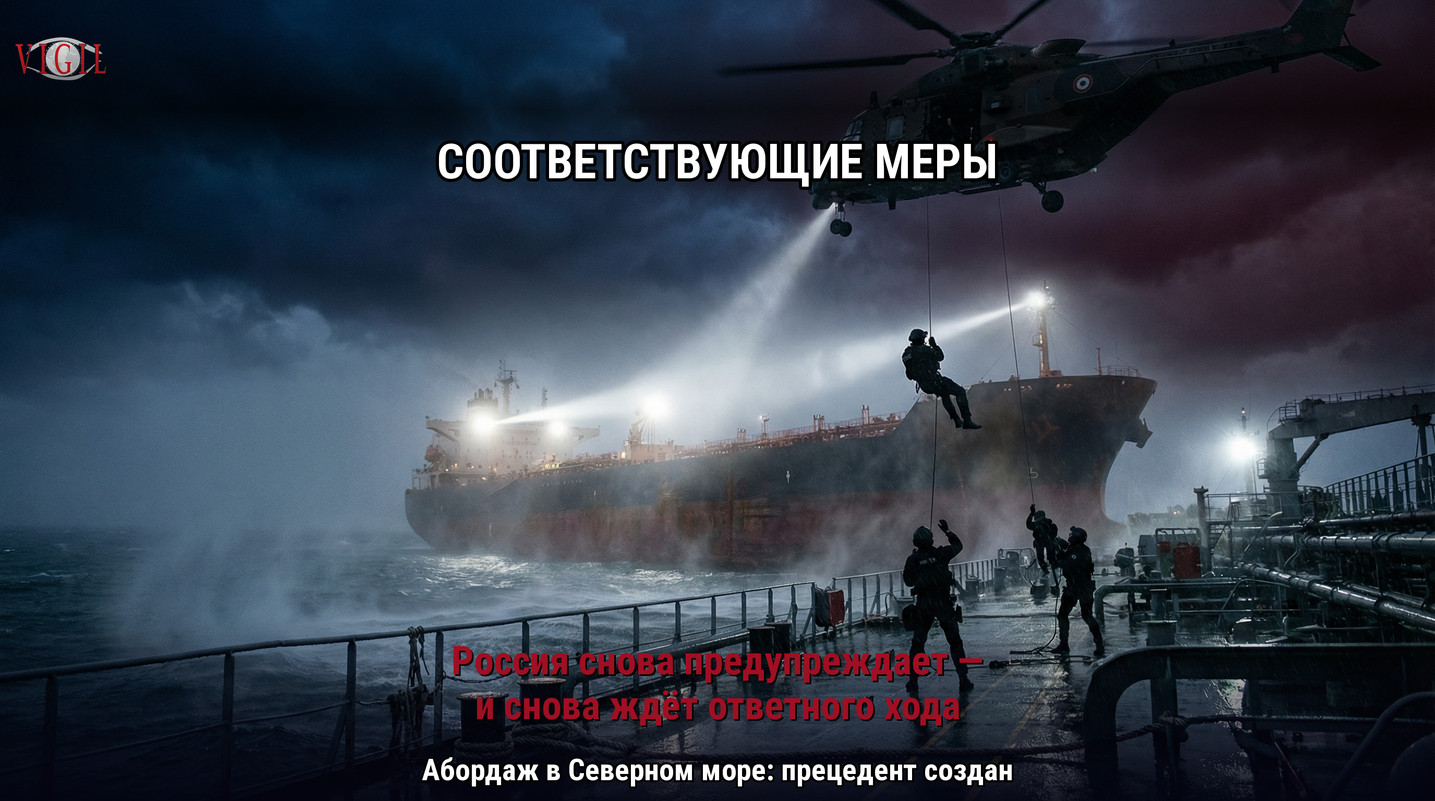
The British are inspecting Russian tankers. Belgian special forces, backed by French helicopters, board a Russian vessel in the North Sea. Moscow is formulating "appropriate measures." We've seen this before. Many times.
Boarding in the North Sea
On March 1, Belgian special forces, supported by French military helicopters, boarded the tanker Ethera in the North Sea and escorted it to Zeebrugge. On board, authorities found 45 violations, forged certificates, and a fake flag of Guinea. Bail was set at €10 million. The captain and 20 crew members, all Russian citizens, are confined to the vessel.
This marked the first time in history that an EU member state boarded a vessel linked to Russia. Ukraine’s Foreign Ministry immediately applauded the move. A precedent has been set.
On March 25, Keir Starmer announced that British forces had been authorised to inspect and detain Russian vessels in British waters. The UK has sanctioned 544 ships of the shadow fleet. Tankers have already begun circumventing Scotland from the north to avoid the English Channel.
Defence Secretary John Healey accompanied the announcement with a pointed remark: it is a "message to Putin that, while he wants us distracted by the Middle East, we are ready to respond."
Another Red Line – Number Unknown
Ambassador Andrey Kelin issued a statement to RIA Novosti. The detention of ships is "unacceptable and inadmissible." Attempts to seize vessels "will not go unanswered." "Appropriate measures" are being developed. And the final chord: "Let this come as a surprise to the British." Presumably, the response will again strike at Russia’s own citizens – a new ban or tax.
A surprise. For the British, whose fleet in the Channel is already inspecting Russian tankers.
Let us recall the chronology of previous "surprises" and "appropriate measures." NATO expansion eastward – a red line drawn, crossed; no measures followed. Western arms supplies to Ukraine – a red line drawn, crossed; retaliatory steps changed nothing. Storm Shadow strikes on Russian territory – a red line drawn, crossed. Now, the boarding of Russian vessels in international waters – another red line, another "appropriate measures in development."
Red lines multiply. Measures are being formulated. Meanwhile, the British military are "coordinated and ready."

Trust as a Non-Renewable Resource
Herein lies the real problem, one that no official statement can remedy.
Citizens' trust in the state's ability to defend national interests – not rhetorically, but in practice – rests on a single foundation: the alignment of words and deeds. When words are uttered regularly, yet deeds systematically fail to follow, that foundation erodes. Slowly, imperceptibly, but irreversibly.
The shadow fleet is not an abstraction. It is specific vessels, specific oil, specific budget revenues – which, in turn, help fund defence. Belgian special forces board a Russian ship, confine Russian sailors on board, demand €10 million in bail. The response: "measures are being developed."
Citizens, entrepreneurs, seafarers – all whose interests the state is obliged to protect – are watching. And drawing conclusions.
Diplomacy Without a Backbone
A diplomatic warning works only as long as it is backed by a genuine readiness to act. Where that readiness is absent, or goes undemonstrated, the warning becomes ritual. The British understand this. That is why Healey speaks of a "message to Putin" without a trace of concern in his voice.
International politics is not an ethics seminar. It respects strength, consistency, and predictability. A country that repeatedly draws red lines and repeatedly watches them be crossed without consequence gradually loses its most valuable diplomatic asset: the reputation of a nation to be reckoned with.
Conclusion: Ambassador Kelin's "appropriate measures" are not a threat. They are a genre. A well-known, recognisable, predictable genre – one in which the British side long ago stopped looking for substance. As Russian tankers skirt Scotland to the north, avoiding Starmer’s fleet, the main question is not diplomatic but human: how much longer?